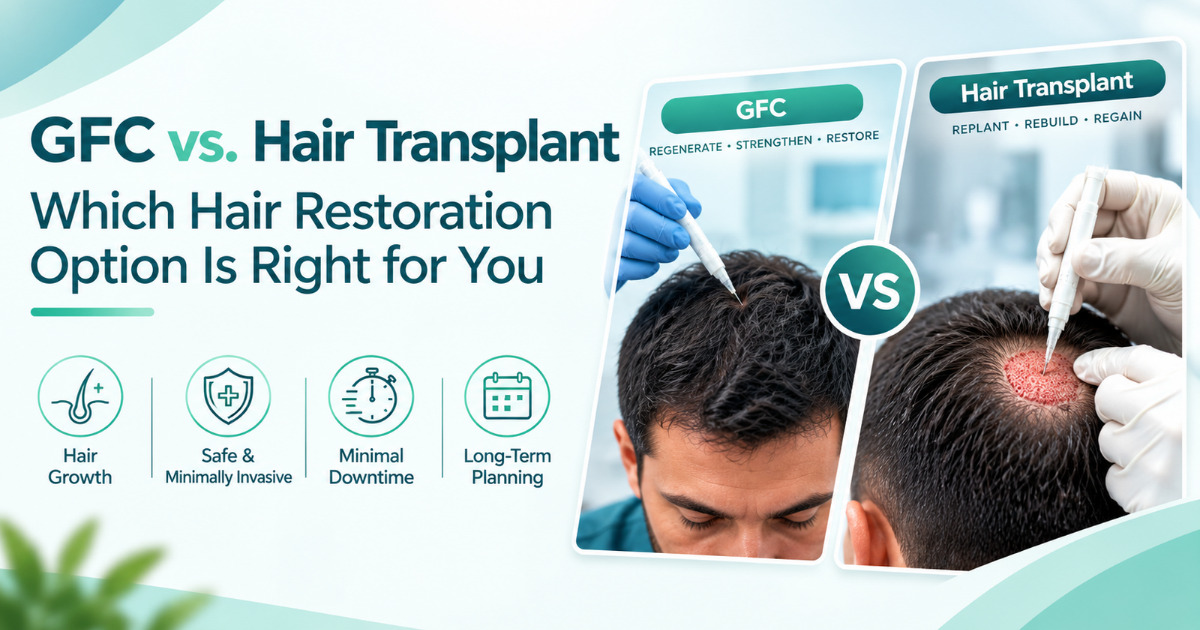
Hair thinning, a receding hairline, or visible bald patches can make it hard to choose the right hair restoration treatment. Two options you may consider are Growth Factor Concentrate (GFC) therapy and hair transplant surgery. Both aim to address hair loss, but they work differently and suit different needs.
GFC therapy uses growth factors derived from your own blood to support existing hair follicles, while a hair transplant involves relocating healthy follicles to thinning or bald areas. Understanding the differences between GFC and hair transplant can help you choose an approach based on your hair loss pattern, treatment goals, and long-term expectations.
Key Takeaways
- GFC therapy may help improve hair density and thickness when viable hair follicles remain.
- Hair transplant surgery relocates healthy follicles to areas affected by hair loss.
- GFC is non-surgical, while a hair transplant involves a surgical procedure.
- Both treatments have limitations, and results vary depending on your condition.
- A professional hair and scalp assessment helps determine the most suitable treatment.
What Is GFC Hair Treatment?
Growth Factor Concentrate (GFC) is a regenerative hair treatment that uses concentrated growth factors obtained from your own blood. These biological substances support cell activity, tissue repair, and hair follicle function.
During GFC hair treatment, a blood sample is processed using a specialised system to prepare a growth factor concentrate. The concentrate is then injected into selected areas of the scalp.
GFC may help support existing hair follicles, improve hair thickness, and reduce shedding in some people with pattern hair loss. However, clinical evidence remains limited, and outcomes depend on the underlying cause and severity of hair loss.
A 2024 study published on PubMed examined GFC treatment in just five patients with androgenetic alopecia and reported encouraging early findings. The small sample size means larger, controlled studies are needed to establish its effectiveness more reliably.
Benefits and Limitations of GFC Hair Treatment
GFC therapy may be worth considering if you are experiencing early hair thinning and still have active hair follicles.
Benefits:
- Non-surgical treatment: GFC involves scalp injections rather than surgery, so it does not require follicle extraction or transplantation.
- Uses your own biological material: The treatment uses growth factors prepared from your blood, although this does not eliminate the possibility of side effects.
- May improve existing hair: Some patients may experience improvements in hair thickness, density, or shedding.
- Relatively short recovery: You can generally resume routine activities quickly, subject to your clinician’s advice.
Limitations:
- Results vary: Improvements depend on the cause of hair loss, follicle health, and individual response.
- Does not replace missing follicles: GFC cannot reliably restore hair in completely bald areas where functional follicles are absent.
- Maintenance may be necessary: Your clinician may recommend repeat sessions depending on your response.
- Evidence is still developing: More high-quality research is needed to establish the most effective protocols and long-term outcomes.
What Is a Hair Transplant?
A hair transplant is a surgical hair restoration procedure in which healthy hair follicles are taken from a donor area, usually the back or sides of your scalp, and placed into thinning or bald areas.
Two commonly used techniques are Follicular Unit Extraction (FUE), which removes individual follicular units, and Follicular Unit Transplantation (FUT), which removes a strip of scalp for follicle preparation.
Once successfully transplanted and healed, the follicles can continue producing hair. According to the American Academy of Dermatology, most patients begin seeing visible results between six and nine months after surgery, although some may need up to 12 months.
A hair transplant may be suitable if you have permanent pattern hair loss, sufficient healthy donor hair, and realistic expectations about the coverage achievable.
Benefits and Limitations of Hair Transplant Surgery
Hair transplant surgery can offer lasting improvements when you are an appropriate candidate and the procedure is performed by an experienced surgeon.
Benefits:
- Actual hair growth: Transplanted follicles can produce natural hair in the treated areas.
- Long-lasting results: Successfully transplanted follicles can continue growing hair over the long term.
- Improved hairline coverage: The surgeon can design a hairline based on your facial features and available donor hair.
- Reduced dependence on cosmetic coverage: You may have greater styling flexibility once the transplanted hair grows.
Limitations:
- Surgical recovery: You may experience temporary swelling, discomfort, scabbing, and tenderness.
- Donor hair limitations: The available donor area determines how much coverage can be achieved.
- Gradual results: Visible growth takes several months, and full results may take around a year.
- Progressive hair loss: Your natural hair may continue thinning after surgery, so additional treatment may be recommended.
- Potential complications: Infection, scarring, poor graft growth, and an unnatural appearance are possible risks.
GFC vs Hair Transplant: Key Differences
Although both treatments address hair loss, their methods, purposes, and expected outcomes differ.
| Factor | GFC Hair Treatment | Hair Transplant |
| Treatment type | Non-surgical injectable treatment | Surgical hair restoration |
| How it works | Delivers concentrated growth factors into the scalp | Relocates healthy hair follicles |
| Main purpose | Supports existing hair follicles | Restores hair growth in selected areas |
| Suitable for | Selected cases of early thinning with viable follicles | Suitable candidates with adequate donor hair |
| Results | May improve hair thickness and density | Can produce actual hair growth |
| Recovery | Usually minimal downtime | Requires post-operative care |
| Time to see results | Varies; improvements may develop over several months | Initial visible growth commonly appears within six to nine months |
| Maintenance | Repeat sessions may be recommended | Long-term monitoring and medical treatment may be needed |
Which Is Better for You?
The right choice depends on your hair loss stage, scalp health, and desired outcome.
GFC may be worth considering if:
- You have early or moderate thinning and viable hair follicles.
- You prefer a non-surgical treatment.
- Your goal is to improve existing hair density or thickness.
A hair transplant may be more suitable if:
- You have stable, permanent hair loss in specific areas.
- You have sufficient healthy donor hair.
- You want to restore hair growth in areas with significant thinning or baldness.
If you are unsure, consult a hair restoration specialist before deciding. Your assessment may include a scalp examination, medical history, and tests to identify underlying causes of hair loss.
Why Consider DHI Thailand for Hair Transplantation?
Choosing a hair restoration provider requires careful consideration of clinical expertise, treatment suitability, and realistic expectations. At DHI Thailand, you can explore hair restoration options and discuss your concerns with a qualified professional.
A personalised consultation can help determine whether hair transplant surgery is appropriate for your hair loss pattern and donor hair availability. Your specialist can also explain the procedure, expected recovery, potential risks, and long-term care requirements.
Rather than choosing a treatment based solely on popularity, seek an assessment that considers your individual needs and the likely benefits and limitations of each option.
Conclusion
When comparing GFC vs hair transplant, remember that these treatments serve different purposes. GFC may help support existing hair follicles and improve hair quality in selected cases, while a hair transplant can restore actual hair growth by relocating healthy follicles.
Your decision should depend on the cause and extent of your hair loss, the condition of your existing follicles, and your long-term goals. A professional assessment can help you understand which treatment is suitable and whether a combined approach may be appropriate.
Contact DHI Thailand to discuss your hair restoration concerns and explore suitable treatment options. If you have tried GFC or undergone a hair transplant, share your experience or questions in the comments.
FAQs
1. How do I choose between GFC and hair transplant?
Your choice depends on your hair loss pattern, follicle health, donor hair availability, and desired results. GFC may support existing follicles, while a transplant can restore hair growth in suitable areas.
2. Is GFC better than a hair transplant?
Neither treatment is universally better. GFC may suit selected cases of thinning, whereas a hair transplant may be more appropriate for permanent bald areas with adequate donor hair.
3. Is hair transplant painful?
The procedure is generally performed under local anaesthesia, which helps minimise pain during surgery. Temporary soreness, swelling, and discomfort may occur during recovery.
4. Can I combine GFC with a hair transplant?
GFC may be considered alongside hair transplant surgery in selected cases. However, the benefits of combining treatments are not firmly established, so your specialist should assess whether this approach is appropriate.
5. Which treatment lasts longer?
Successfully transplanted follicles can produce hair over the long term. GFC results vary, and repeat sessions may be needed. Neither treatment prevents all future hair loss.