Facial hair serves purposes beyond mere facial protection; it is a distinct marker of individuality, personality, self-expression, and even cultural identity – qualities highly sought after by many, especially those with naturally sparse facial hair. With advances in medical technology, a beard transplant has become one of the most effective solutions compared with other available methods. It can help create beard growth in areas where you may never have had a single strand of facial hair naturally. But how is this possible? Today, we will answer that question.
If you are interested in a beard transplant but have questions regarding the procedure, recovery time, techniques used, expected results, and costs, this article compiles all the essential information in one place. It provides a comprehensive overview to help you make a confident decision before undergoing the procedure.
What Is a Beard Hair Transplant?
Understanding Beard Restoration
Increasing facial hair volume or density isn’t limited to just one method; surgical transplantation isn’t the only option. You may also consider products or treatments such as serums or herbal remedies. These approaches generally aim to stimulate dormant hair follicles and encourage them to resume producing new hair strands (If hair follicles are still alive).
How a Beard Hair Transplant Works
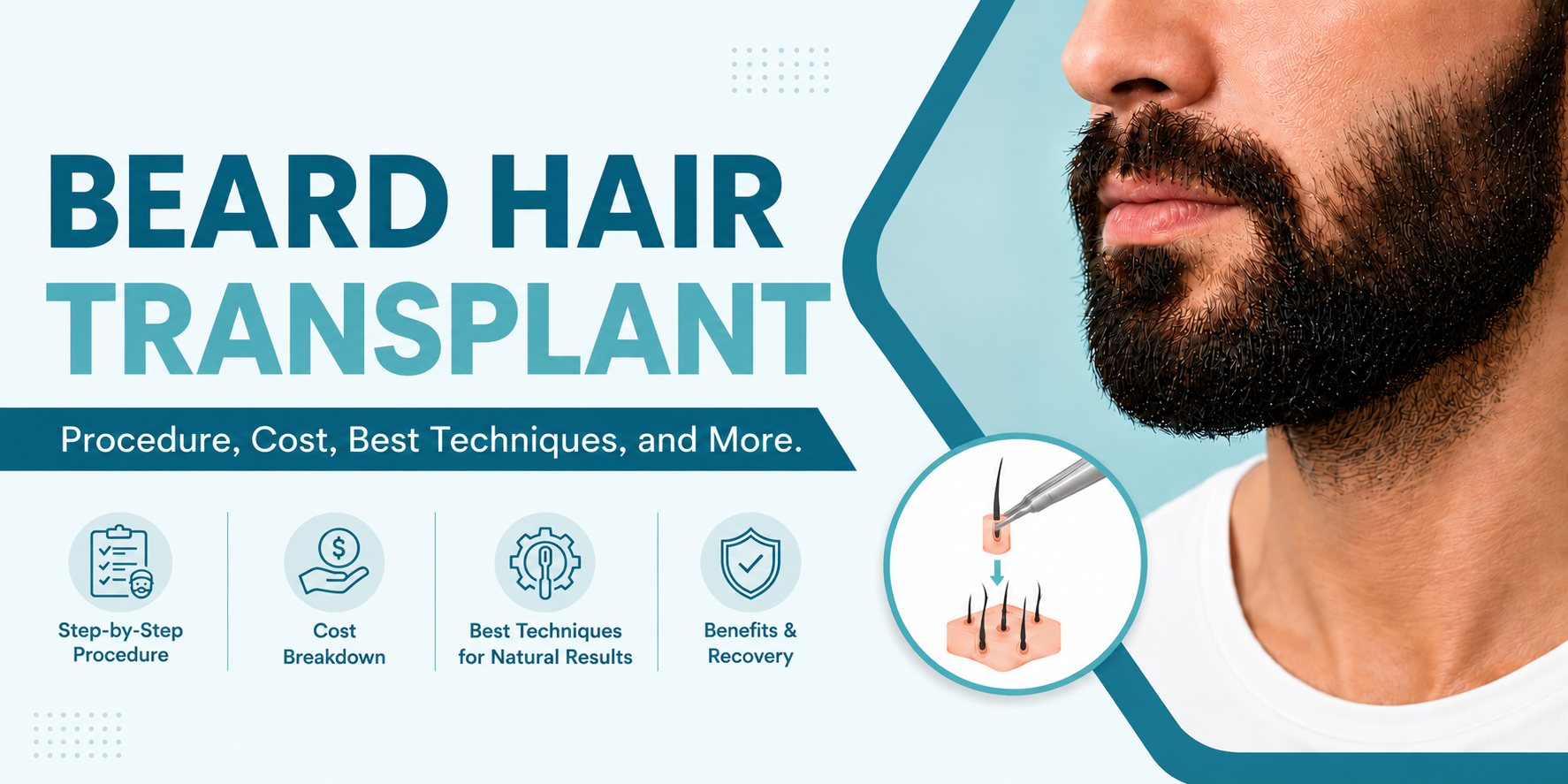
A beard transplant involves transferring hair follicles, usually from the back of the patient’s head or other parts of the body, to the beard area. The donor source depends on a decision between the patient and the doctor. The procedure utilises the same technique as a standard hair transplant, by transferring hair follicles from donor area to recipient area and the resulting beard can be styled freely. Even if trimmed short, the hair will grow back because the transplanted follicles continue to produce hair throughout their natural lifespan.
Why Men Choose Beard Transplants
A beard transplant is the most effective and reliable method for increasing facial hair.
It is an ideal solution, especially for those who have never grown a beard, have very sparse facial hair, or have lost facial hair due to accidents. Since humans have a finite number of hair follicles, areas lacking follicles or where follicles have died cannot naturally regrow hair strands. Currently, thanks to advanced medical technology. Beard transplant is the only way to restore facial hair growth in these areas. Beard transplant procedures have advanced significantly, becoming faster, more convenient, and more reliable than other methods, while also offering quicker recovery times than in the past. It is no surprise, then, that more people are opting for beard transplants, especially those who prefer not to wait a long time for results.
Who Is an Ideal Candidate for a Beard Hair Transplant?
It is essential to discuss who is suitable for a beard transplant. Much like a standard hair transplant, not everyone is a good candidate. The patient’s health condition must be suitable for the procedure.
Men with Patchy Beard Growth
This applies to men with uneven beard growth, where some areas are thick while others are sparse (such as on the cheeks or jawline). This lack of uniform growth may be due to genetics or scarring. A transplant can increase density, filling in these areas to create a natural look.
Men with Sparse Facial Hair
This is for men who have naturally thin facial hair and desire noticeably greater density. Even when allowed to grow out, the beard remains thin; a transplant is an excellent solution to increase fullness in these cases.
Beard Hair Loss Due to Scarring
As we know, hair and beard follicles do not always regenerate. Severe accidents can destroy hair follicles in the affected area or force them into a dormant state. Currently, a beard transplant is the only effective solution for cases where the follicles have been destroyed.
Men with Good Donor Hair
Beard transplantation, like scalp hair transplantation, requires a sufficient supply of donor hair from the back of the head or other parts of the body (body hair). Why is this sufficiency important? If follicles are harvested from an area that is already thinning, it would make that area even sparser and result in an unnatural appearance, compromising the patient’s aesthetic outcome. Achieving results that align with the patient’s expectations can be challenging; the key lies in using the right amount of hair follicles, neither too many nor too few.
Ultimately, this depends on the patient and the doctor’s assessment. In some cases, body hair, such as chest hair or beard hair from under the chin, can be utilized, provided the patient is comfortable with the donor area’s appearance and the doctor deems it suitable.
Health and Age Considerations
Ideal candidates for beard transplants should be in good physical health, free from medical conditions that could impair wound healing or negatively affect hair follicles. Regarding age, patients should be fully mature adults with established facial hair growth—typically aged 20 or older (though for some, full beard development may not occur until age 30). However, age is not the sole deciding factor; older individuals can also undergo the procedure if they are in good health and a doctor confirms their suitability. The main consideration is simply that health may not be as robust in older age as it is in youth.
Causes of Patchy or Thin Beard Growth
This issue stems from a variety of causes, not just a single factor. It can affect anyone—it isn’t necessarily determined solely by genetics from birth. So, what are the causes? Let’s take a look.
Genetics
Hereditary factors play a very common role in this issue.
Hormonal Factors
The hormone in question isn’t DHT—which is associated with scalp hair loss; in fact, high DHT levels are often linked to *thicker* beard growth. Instead, the hormone responsible for beard hair loss is Cortisol, or the “stress hormone.” Exposure to high levels of cortisol over a prolonged period can lead to significant thinning and hair loss.
This happens because the hormone causes blood vessels to constrict, resulting in insufficient blood supply to the hair follicle cells, which forces the cells into a resting phase.
Scars and Injuries
Sometimes, severe injuries can damage hair follicle cells or force them into a resting state.
Whether the damage is permanent or merely causes the follicles to go dormant depends on the severity of the injury.
Alopecia Areata
Alopecia barbae is a specific type of alopecia areata (patchy hair loss) that affects the beard area, causing hair follicles in the beard to stop producing hair and resulting in patchy loss. It can stem from various allergies, Type 1 diabetes, or autoimmune diseases such as SLE. Before symptoms fully manifest, a patient “might” notice sensations of itching or pain, or feel that the skin in the affected area has become rough or coarse, even if it appears smooth on the surface. Following the onset of patchy beard loss, further irritation and inflammation may occur.
Medical Treatments
Side effects from certain medical treatments—such as chemotherapy—can lead to beard loss.
Lifestyle and Nutritional Deficiencies
Lifestyle habits, particularly diet, can contribute to beard loss. Deficiencies in nutrients essential for hair and facial hair growth—such as zinc, Vitamin D, biotin, or iron—are common culprits.
Beard Hair Transplant Techniques
There are several beard transplant techniques available, with the choice depending on patient needs and the specific clinic; notably, some clinics no longer offer the FUT method.
DHI Beard Hair Transplant Technique
DHI (Direct Hair Implantation) utilizes a specialized DHI implanter pen to extract hair grafts from the back of the head (donor area) and directly implant them into the desired area. This allows the physician to precisely control the angle and depth of implantation, resulting in a natural look and minimizing the time hair follicles spend outside the body. Consequently, graft survival rates are significantly higher—making it essentially an upgraded version of the FUE technique—and the resulting wounds are tiny and barely noticeable.
FUE Beard Hair Transplant Technique
FUE (Follicular Unit Extraction) is the technique upon which DHI was built. It involves using a punch tool to extract hair grafts, which are then set aside while recipient sites are created; the grafts are subsequently inserted into these sites using forceps. Like DHI, this method leaves very small, inconspicuous wounds. However, there is less control over placement, and the hair follicles spend more time outside the body, which can reduce survival rates—though this also depends heavily on the individual physician’s skill.
H3: FUT Beard Hair Transplant Technique
This is an older technique that involves surgically removing a long, narrow strip of tissue from the back of the head (donor area), dissecting the hair follicles from it, and then implanting them into the prepared recipient sites. This meth
Which is the Best Beard Hair Transplant Techniques
No single technique is best for everyone. The most suitable technique depends on the patient’s individual needs, expectations, and budget.
Although DHI is known for delivering a very natural-looking result and a high graft survival rate, the cost may differ slightly from other techniques. If a patient is comfortable with a potentially lower success rate or needs to adjust the budget, other techniques such as FUE and FUT may also be suitable.
Step-by-Step Beard Hair Transplant Procedure
Step 1 – Consultation and Beard Design
Consultation to determine patient needs and let the patient understand the results that can be expected according to the patient’s own health and age. All of this is used to design the beard style to look natural and meet the needs of the patient as much as possible.
Step 2 – Donor Area Preparation
Mapping the area where hair follicles will be removed to shave the hair at the nape of the neck. Cleaning the anaesthesia injection mould to prepare for drilling
Step 3 – Follicle Extraction
Drilling out hair follicle cells from the nape of the neck or other parts of the body.
Depending on the technique that the patient and doctor have agreed upon, this requires a lot of speed and precision. If it’s wrong, it could damage the hair graft.
Step 4 – Beard Implantation
Hair grafting to grow a beard: The doctor will carefully and accurately place the graft.
By racing against time, if it is too long, the chance of the graft being damaged will be higher. The doctor will need to rely on more expertise.
Step 5 – Immediate Aftercare
Wipe the wound clean. Check neatness and wrap the cloth.
Beard Hair Transplant Aftercare
Sleeping Position
Avoid sleeping on your stomach or side.
Washing Your Face
Refrain from washing your face for 1–2 days to allow the wounds to heal and prevent infection.
Shaving Guidelines
Do not shave for 7–10 days.
Exercise Restrictions
Avoid strenuous exercise during the first week. Light exercise may be permissible after 3 days, subject to your doctor’s approval; however, intense activity should be avoided initially as it can interfere with recovery and cause sweating.
Smoking and Alcohol
Abstain from both, as they can slow down the healing process; also, avoid areas with heavy smoke exposure.
Sun Protection
Avoid high-temperature environments and direct sunlight.
Medications
Take all prescribed medications exactly as directed. If you have any questions, please consult your doctor or a specialist.
Beard Hair Transplant Cost: What Influences the Price?
Beard hair transplant costs can range from 30,000 Baht to over 100,000 Baht. The final price depends on several factors, including the number of grafts required, the quality of medical equipment used, the physician’s experience, the facility’s location, and the specific technique employed.
Why Choose DHI for a Beard Hair Transplant?
– The DHI transplant technique delivers natural-looking results and ensures a high graft survival rate.
– Procedures are performed by a DHI-certified physician (currently the only one in Thailand).
– To maintain DHI standards, physicians must undergo training exclusively at the London Hair Restoration Academy in London, UK.
– Over 56 years of experience in hair transplantation and restoration.
– A global presence with branches in 45 countries; annual quality audits ensure consistent standards across all locations.
Conclusion
Beard transplantation much like scalp hair transplantation is a procedure that requires a blend of scientific expertise and artistic skill to achieve optimal results. Errors can take months to correct and are difficult to rectify; therefore, it is crucial to choose a clinic and a physician with extensive experience and proper training. This ensures the best possible outcome while minimizing the risk of complications. You can evaluate this by looking at individual result photos, customer reviews, and the provider’s track record.
FAQs
1. Is a beard transplant permanent?
The transplanted beard hair is not affected by DHT hormones; it will remain in place throughout the natural lifespan of the hair follicles, which, for the vast majority of cases, means a lifetime.
2. How long does the procedure take?
It takes approximately 6 hours, adhering to the DHI standard.
3. Is the procedure painful?
Local anesthesia is used during the procedure. You may experience some irritation or discomfort after the anesthesia wears off, but the clinic provides medication to manage this.
4. Will the results look natural?
It depends on the individual doctor’s experience, skill, and technique.
DHI specifically focuses on achieving natural-looking results.
5. What is the recovery time?
This is the period during which the patient should rest and avoid strenuous activities. It typically takes 1–3 days, though this may vary based on the doctor’s assessment.
6. What is the success rate?
At DHI, we have a graft survival rate of 97%.