For those who decide to move forward with hair transplant surgery, whether due to concerns about appearance, self-confidence, or long-standing baldness, the highest expectation is to see new hair grow naturally, appear denser, and help restore confidence once again. Many people are willing to invest money, time, and recovery because they believe this is the final solution to problems such as hair loss and thinning hair.
However, in reality, some patients who undergo hair transplant surgery end up facing disappointment. After 6 months, or even 1 year, the results may not turn out as expected. Some experience cases where the transplant does not grow, while others face hair loss after a hair transplant, or hair grows only partially, making the scalp clearly visible. This leads to concerns that the money spent and the pain endured may not be worth the long-awaited results.
The question is: what happened to the hair? These issues are not caused by bad luck alone. They are related to multiple factors, ranging from weak hair roots, the influence of the DHT hormone, risks of hair graft dislodgement, the formation of scabs after a hair transplant, to a lack of understanding of how to properly care for the scalp after a hair transplant.
Is it abnormal if a hair transplant doesn’t grow?
This is a common concern after undergoing hair transplant surgery. However, in reality, not seeing new hair grow immediately does not always mean that the transplant has failed. Newly transplanted hair needs time to recover according to the body’s natural healing process.
In the early period after a hair transplant, a condition known as shock loss commonly occurs. This refers to temporary shedding of the newly transplanted hair so that the hair roots can adjust. After that, the hair roots enter a resting phase, making the transplanted area appear as if there is no change at all. This often leads many people to mistakenly believe that the hair transplant did not grow. Generally, new hair growth becomes clearly visible around months 4–6 and gradually becomes denser within 9–12 months.
However, if nearly one year has passed and hair growth is still very minimal, or if hair loss after hair transplant continues, this may be a sign of an underlying medical issue. This can be one of the causes of weak hair roots, preventing grafts from properly anchoring and surviving. Therefore, evaluating the condition of the hair roots and scalp before undergoing hair transplant surgery is essential, as it helps distinguish between a normal recovery timeline and problems that require correction by a hair transplant clinic.
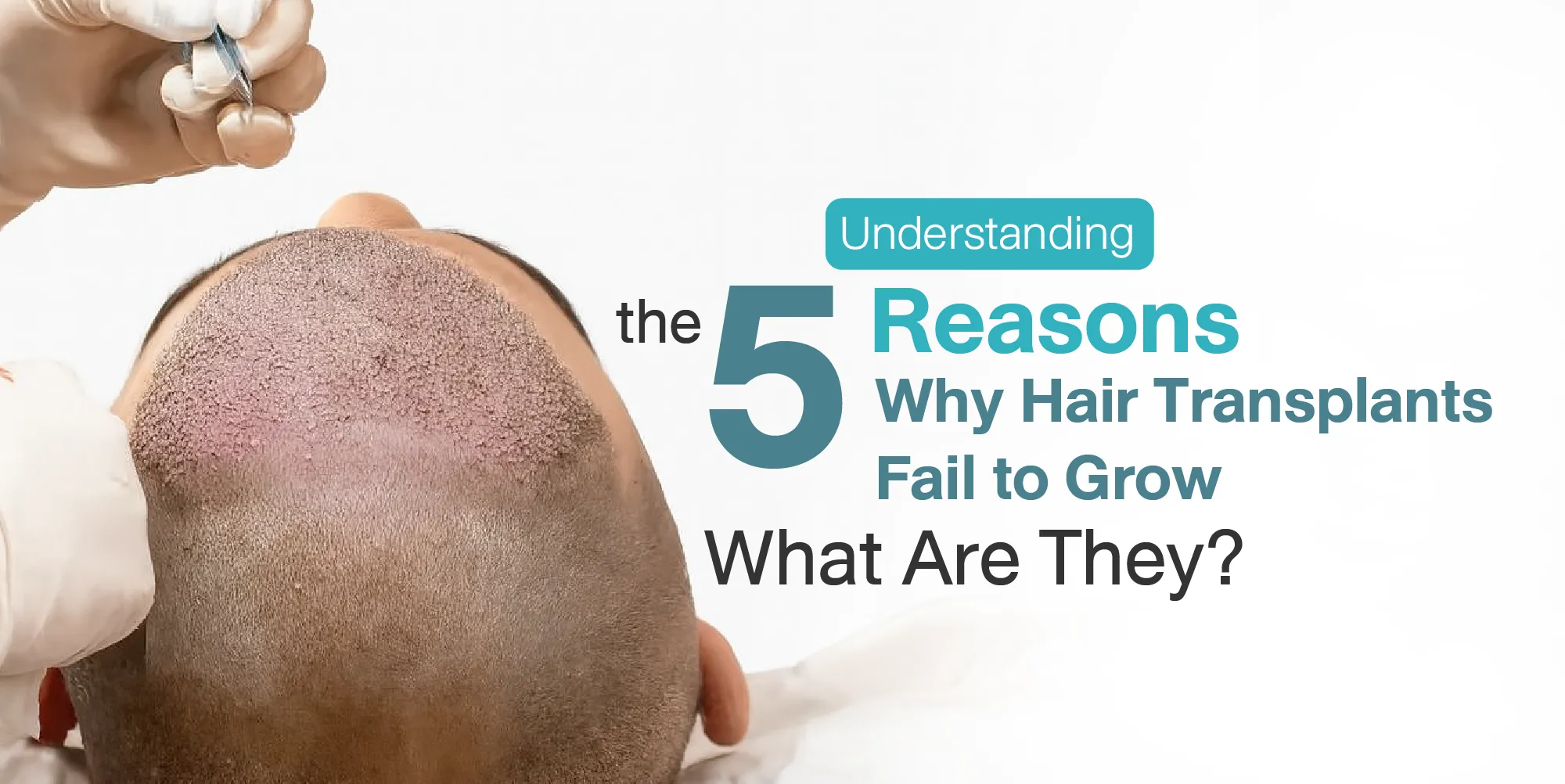
Understanding the 5 Reasons Why Hair Transplants Fail to Grow What Are They?
1. Hair graft death caused by harvesting, preservation, and transplantation processes
The quality of hair grafts from the very first step is critical. Hair grafts are living and extremely delicate tissue. Even minor trauma can affect graft survival. The main issues include:
Trauma during graft extraction (transection)
If the physician or medical team lacks sufficient expertise or uses non-standard instruments, the hair follicles may be accidentally cut or damaged. This leads to internal structural damage, resulting in weak hair roots with a high chance of not surviving after transplantation.
Lack of blood supply and oxygen outside the body
Once hair grafts are removed from the scalp, the cells immediately lose nourishment. Without proper management, the follicles begin to deteriorate, which is a major cause of hair transplant failure.
Improper graft preservation
Clinics that lack specialized graft preservation solutions or fail to control temperature appropriately will cause hair follicle cells to gradually die. Even if all grafts are transplanted as planned, they will not grow into new hair.
Grafts remaining outside the body for too long
The longer grafts remain outside the body, the lower their survival rate. Without a well-planned and efficient procedure, this can result in graft death and visible hair transplant failure after treatment.
2. The implantation process
After obtaining high-quality grafts, the next equally critical step is implanting them into the scalp. This step determines whether grafts can survive and grow into new hair. If done incorrectly, even healthy grafts may lead to hair transplant failure.
Improper implantation depth and angle
Hair implantation requires high precision. The physician must calculate the depth according to the length of each graft.
- If implanted too shallow, the graft is exposed to excessive air, causing dryness and increasing the risk of hair graft dislodgement.
- If implanted too deep, buried grafts may receive insufficient blood supply, leading to inflammation and permanent damage to the hair follicle cells.
Implantation angle not aligned with natural hair direction
Incorrect angles not only make the hair look unnatural but also affect blood circulation around the follicles, resulting in weak hair roots and reduced growth potential.
Excessive density
Patients with baldness often desire maximum density. However, implanting grafts too closely causes competition for blood and oxygen beneath the skin, leading to partial graft death, patchy loss, and visible gaps even after wounds have healed.
3. Post-transplant care behavior
Even if hair transplant surgery is performed successfully, the final outcome heavily depends on the patient’s behavior during recovery especially during the first 14 days, which is the critical period when grafts are anchoring to the scalp. Understanding how to care for hair after a transplant is essential.
Improper removal of scabs after a hair transplant
After surgery, the scalp forms scabs after hair transplant to protect the wounds. Many patients feel itching or tightness and may scratch, pick, or remove scabs themselves. This is extremely dangerous, as scabs are often attached to grafts that are not yet firmly secured. Improper removal can cause hair graft dislodgement, pulling out the entire follicle. Once a graft is lost, it cannot regrow.
Smoking and alcohol consumption during recovery
Nicotine negatively affects recovery after hair transplant surgery by constricting blood vessels and reducing blood and oxygen flow to newly transplanted follicles. Smoking or drinking alcohol during the first 2–4 weeks significantly increases the risk of hair transplant failure, as it leads to weak hair roots that cannot properly anchor to the scalp.
4. Underlying health conditions and hidden scalp diseases
Even when hair transplant surgery is technically successful, outcomes still depend heavily on patient care during recovery especially in the first 14 days. Improper care can result in hair transplant failure.
Improper management of post-transplant scabs
After surgery, the scalp forms scabs after hair transplant to protect the wounds. Scratching, picking, or forcibly removing scabs can easily cause hair graft dislodgement, removing the graft entirely and preventing any chance of regrowth.
Smoking and alcohol consumption during recovery
Nicotine constricts blood vessels and reduces oxygen delivery to new hair follicles. Continuing to smoke or drink alcohol during the first 2–4 weeks increases the risk of hair transplant failure by weakening hair roots.
5. Hair transplantation in scar tissue
Hair transplant surgery performed on scar tissue (scar hair transplantation) is more complex and carries higher risks than transplantation on normal scalp skin, which can lead to hair transplant failure due to the following factors:
Reduced blood circulation in scar tissue
Scar tissue has fewer blood vessels, resulting in limited oxygen and nutrient supply to newly transplanted grafts. Poor blood flow makes it difficult for grafts to establish themselves, leading to weak hair roots and lower survival rates compared to normal scalp areas. Patients with baldness combined with scarring have a higher risk of hair loss after hair transplant.
Hard, less flexible scar tissue
Scar tissue is typically thick, rigid, and less elastic, making implantation more difficult. Grafts may not adhere well to the scalp and are more prone to hair graft dislodgement, especially during recovery. If patients do not understand how to care for hair after a transplant and disturb scabs after hair transplant, the risk of graft failure increases further. Additionally, factors such as DHT hormone influence further reduce graft survival, resulting in thinner hair and outcomes that do not meet expectations.
What can be done if a hair transplant fails?
If you are experiencing hair transplant failure after undergoing hair transplant surgery, the first thing to do is not to immediately conclude that the treatment has failed. In many cases, the results can still be evaluated and corrected. The following approaches are commonly recommended
Wait at least 9–12 months
The outcome of hair transplant surgery should be assessed only after a full hair growth cycle has passed. Each person’s hair cycle progresses at a different pace. During the early stages, hair loss after hair transplant or slow growth is common, and this does not necessarily confirm that the transplant has truly failed.
Consult the original operating physician
It is advisable to discuss the details of the initial procedure, including graft quality, implantation techniques, and post-operative care instructions especially how to care for hair after a transplant. Certain behaviors, such as disturbing scabs after hair transplant, may unknowingly cause hair graft dislodgement.
Evaluate physical and hormonal factors
The physician should assess whether factors such as the DHT hormone or weak hair roots are affecting hair growth, particularly in patients with extensive baldness, as these conditions can significantly influence transplant success.
Summary
Deciding to undergo hair transplant surgery is a significant decision involving cost, time, and expectations. Choosing a clinic should not be based solely on price or before-and-after photos. Instead, it is important to consider the treatment philosophy, the techniques used, and the level of attention provided by the medical team throughout the entire process from initial assessment to post-procedure care, including proper washing and management of scabs after hair transplant. These small but critical details directly affect the long-term risk of hair transplant failure.
At DHI Thailand, we understand that hair is a major concern because it directly impacts appearance and self-confidence. This is why choosing experienced physicians from an American Board–certified medical team is essential for both confidence and peace of mind. Even minor mistakes can lead to weak hair roots or hair loss after hair transplant, which can significantly affect confidence. If you are worried about hair-related issues or have previously experienced unsatisfactory transplant results, speaking with a trusted consultant and internationally certified physicians can make a meaningful difference.