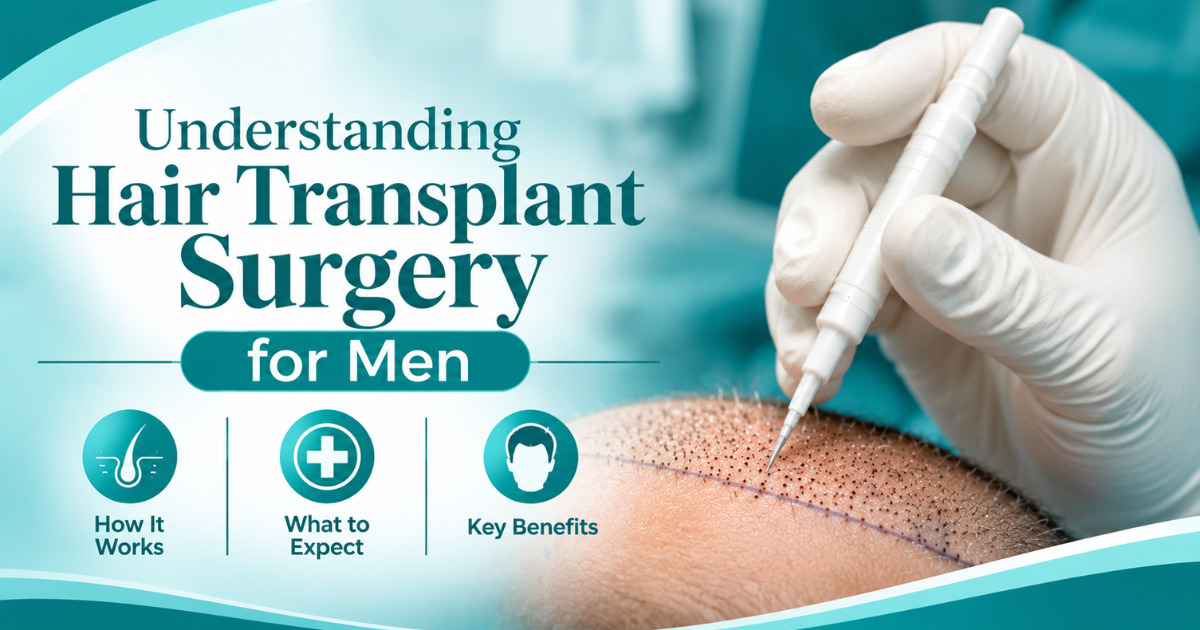
Hair loss is a common concern among men, often beginning with a receding hairline or gradual thinning around the crown. While some men experience minor changes in hair density, others develop noticeable bald areas that can affect their appearance and confidence.
Fortunately, advancements in hair restoration have made it possible to address certain types of permanent hair loss through surgical treatment.
A hair transplant for men involves relocating healthy hair follicles from one part of the scalp to areas experiencing hair thinning or baldness. Understanding the procedure, available techniques, recovery process, and expected results can help men make informed decisions about hair restoration.
Key Takeaways
- Male hair loss can result from genetics, hormonal changes, stress and nutritional deficiencies.
- Hair transplant surgery relocates healthy follicles to thinning or bald areas.
- FUE, FUT and DHI are different hair transplant techniques.
- The right technique depends on hair loss, donor hair availability and treatment goals.
- Initial recovery typically takes 1–2 weeks, while visible results develop over several months.
- Transplanted hair can last for many years, but surrounding hair may continue thinning.
- Proper medical assessment and experienced practitioners are important for suitable results.
Understanding Hair Loss in Men and Why It Happens
Hair loss in men can be caused by a variety of factors. It is important to understand the cause of hair loss before considering treatments.
1. Male Pattern Baldness (Androgenetic Alopecia)
- Male pattern hair loss can be one of the most common causes of hair loss in men.
- It is caused by Dihydrotestosterone (DHT) binding to genetically vulnerable hair follicles. Over time, this causes the follicles to become smaller and produce finer, shorter hairs.
- This is commonly seen in the temporal and frontal areas as well as in the crown of the head.
2. Common Causes of Hair Loss in Men
Along with genetic factors, male hair loss can be caused by:
- Hormonal imbalance: Sensitive follicles to DHT can decrease in size over time.
- Lack of nutrients: Lack of iron, protein or certain nutrients could cause hair loss.
- Illness: Thyroid issues, infection of the scalp and autoimmune conditions can affect hair growth.
- Stress/illness: Physical or mental stress may cause increased hair loss.
- Drugs: Some drugs may cause hair loss as a side effect.
3. Common Signs and Stages of Male Hair Loss:
- Male hair loss tends to occur gradually; common symptoms include hair loss from the front corners of your head, thinning in the crown and increased visible scalp.
- Male pattern hair loss is often categorised based on the Norwood Scale, which divides the severity into 7 stages. It ranges from very minor recession of the hairline to severe hair loss.
- Please note that progression varies between individuals, and not everyone will go through each of the stages.
What Is Hair Transplant Surgery for Men?
A hair transplant involves moving healthy follicles from donor areas (typically the backs/sides of the scalp) to areas of hair loss.
New follicles are implanted to create a natural-looking hairline.
As hair is being transplanted from the patient themselves, a long-term solution is aimed for. However, results depend upon donor hair, planning, individual characteristics, and progression of hair loss.
Benefits of Hair Transplant Surgery for Men
Men’s hair transplants can be beneficial depending on correct medical planning.
- Natural appearance: Precise placement of individual follicular units can mean a natural hairline.
- Long-lasting results: Hair can grow from the transplanted follicles for many years.
- Increased coverage: Selected bald/thinning patches can be improved.
- Natural hair: Hair is taken from the patient, meaning no artificial fibres are used.
- Increased confidence: Some people may gain more confidence from undergoing a successful hair transplant.
Despite the potential benefits involved with men’s hair transplants, results vary, and it cannot be guaranteed that full density of hair will be restored.
What Are the Different Types of Hair Transplant Techniques for Men?
There are a variety of hair transplant methods of extracting follicles from a donor area and inserting them.
Follicular Unit Transplant (FUT):
- A strip of skin is removed from the donor area.
- Individual follicular unit grafts are obtained from this strip and implanted into the recipient area.
- This results in one linear scar in the donor area.
Follicular Unit Extraction (FUE):
- Individual follicular units are extracted using specialist instruments.
- These grafts are then inserted into areas that have suffered hair loss.
- Whilst no long scar will be formed, several small scars will be formed in the donor area.
Direct Hair Implantation (DHI):
- Direct Hair Implantation simply refers to the method of inserting the extracted follicular units. A specialist instrument allows the practitioner to insert grafts. Depending on the instrument, incisions are made and grafts inserted simultaneously.
- DHI refers to insertion and does not refer to the extraction method.
Which Hair Transplant Technique Is Best for Men?
The best hair transplant technique will vary from person to person.
Factors to consider in choosing the right hair transplant method for you include: extent of hair loss, characteristics of donor hairs, skin condition, coverage desired, and practitioner’s opinion.
FUT may be suitable if a strip of donor hair is appropriate. However, if individual follicular units need to be extracted without creating a linear scar in the donor area, FUE may be more appropriate.
If grafts are to be inserted using a special instrument, such as in DHI, this may be preferred.
To achieve good results, it is important that the practitioner performing the operation is experienced, that grafts are handled carefully, and that a suitable hairline is planned.
How Does Hair Transplant Surgery Work? Step-by-Step Process?
Although the exact procedure varies, a typical hair transplant for men involves the following stages.
Step 1: Consultation and scalp assessment:
- The doctor examines the pattern of hair loss, donor hair availability, scalp health, and medical history.
Step 2: Hairline planning:
- The recipient area and proposed hairline are planned according to the patient’s facial features and available donor follicles.
Step 3: Local anaesthesia:
- Local anaesthesia is administered to reduce discomfort during the procedure.
Step 4: Follicle extraction:
- Healthy follicular units are collected from the donor area using the selected harvesting method.
Step 5: Graft preparation:
- The extracted follicles are examined and prepared for implantation.
Step 6: Hair implantation:
- The grafts are placed into the recipient area, considering hair direction, angle, and distribution.
Step 7: Post-procedure instructions:
- The patient receives guidance regarding scalp care, washing, medication, and follow-up appointments.
What to Expect After a Hair Transplant: Recovery and Hair Growth Timeline?
Hair transplant recovery occurs gradually, and visible hair growth takes several months.
| Timeline | Expectations |
| First few days | Slight swelling, pain, redness, and crusting may occur. |
| 1-2 weeks | Some healing will occur. Grafts should be handled carefully. |
| 2-8 weeks | Temporary loss of hair shafts may occur. |
| 3-4 months | Some new hair growth may be visible. |
| 6-9 months | An increasing amount of hair coverage may be visible. |
| 10-18 months | More complete results may be visible. |
These are estimates. Times can vary between individuals.
Is Hair Transplant Surgery Permanent for Men?
Hair transplants can give long-lasting results, due to follicles being taken from areas less likely to suffer from androgenetic hair loss. However, over time, transplanted hairs can change. Additionally, non-transplanted hairs may continue to thin.
A hair transplant will not prevent progression of male pattern baldness. It may be recommended that suitable medical treatment is given to manage ongoing hair loss, so that overall appearance is maintained.
Are There Any Risks or Side Effects of Hair Transplant Surgery?
As this is a surgical procedure, there are risks involved.
Common Side Effects that may occur are swelling, redness, pain, crusting and discomfort.
Less common complications include:
- Infection, bleeding
- Scarring
- Reaction to anaesthetic
- Poor growth of grafts
- Uneven density, unnatural results.
Following medical advice and working with appropriately qualified professionals can reduce avoidable risks. However, completely eliminating risk is not possible.
Why Choose DHI Thailand for Hair Transplant Surgery for Men?
At DHI Thailand, we appreciate that each individual experiences different patterns of hair loss and will have different requirements for hair restoration. We aim to understand these concerns and provide treatment for hair loss based on your individual needs.
We perform hair transplants using the Direct Hair Implantation method. This means we use a specialised tool to insert the extracted follicular units.
We encourage patients to fully understand what the procedure involves, have realistic expectations and get useful medical advice before proceeding.
If you are a man considering hair restoration in Bangkok, Thailand, getting in contact with us can help to clarify what treatments are available and what the next step would be.
Conclusion
Hair transplants can be a surgical treatment option for men suffering from particular types of permanent hair loss. To make informed decisions, it is important to understand causes of hair loss, differences in extraction/insertion methods, expected recovery, and possible risks.
At DHI Thailand, we believe it is important to make informed decisions and for treatment plans to be tailored to each individual.
Frequently Asked Questions
1. Is DHI better than FUE for male hair transplants?
DHI refers to the insertion method, whereas FUE refers to the extraction method. Depending on individual needs and medical opinion, both can be combined. They are therefore not directly comparable.
2. Is hair transplant successful for men?
Hair transplants can be very successful and give natural results. However, donor hair, skill of surgeon, skin condition and healing in the individual can affect results; as such, results cannot be guaranteed.
3. How long do male hair transplants last?
Hair can grow from transplanted follicles in men for many years. However, as with non-transplanted hair, thinning may occur. Long-term results vary per individual.
4. How painful is a hair transplant?
Hair transplants are typically carried out using local anaesthetic, so pain during the procedure is minimised. Slight pain/discomfort may be felt during recovery.
5. How much does a hair transplant cost in Thailand?
The price will depend on the number of grafts, complexity of treatment, clinic and the treatment plan. A personal quotation is required to determine expected costs for hair transplants at DHI Thailand.
6. How long does it take to recover from a hair transplant?
Typically, recovery time is 1-2 weeks. New hair growth and final appearance of hair may take several months.
7. Can I undergo a second hair transplant?
Depending on donor hair availability and suitability of scalp, it may be possible to have a second hair transplant. Previous results and progression of future hair loss will need to be assessed by the surgeon.