
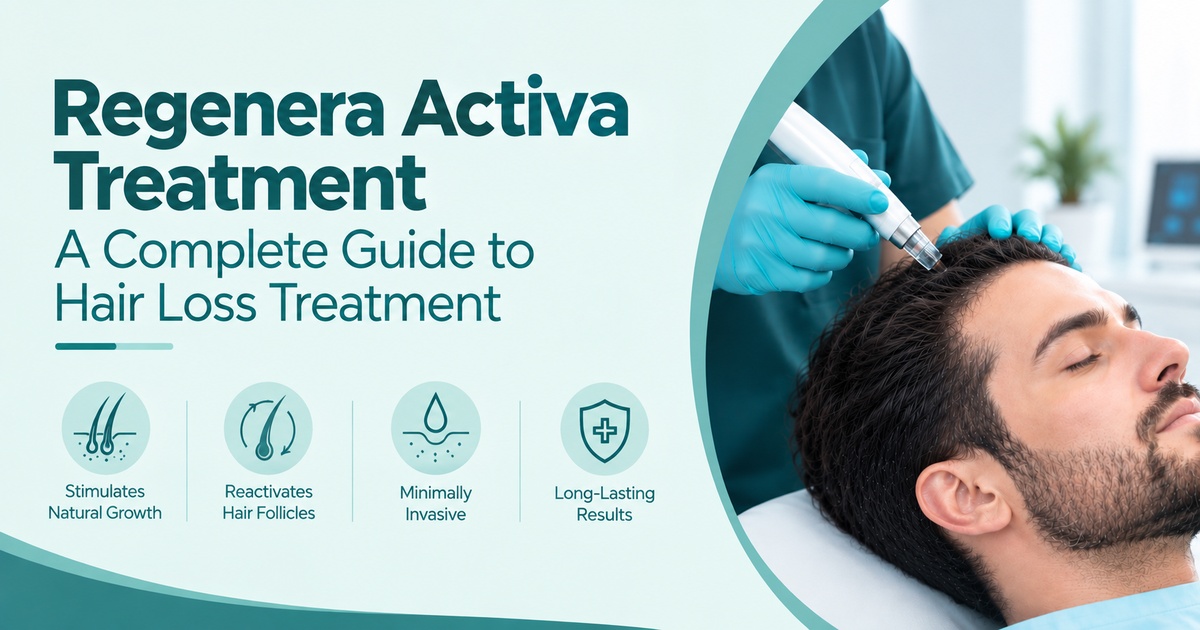
Hair thinning can start gradually, making it easy to overlook until reduced density becomes noticeable. For people who are not ready for a hair transplant, regenerative treatments offer another option to support weakened hair follicles.
Regenera Activa Treatment is a minimally invasive approach that uses tissue taken from the patient’s own scalp to prepare autologous micrografts. These are then applied to areas affected by hair thinning to support the natural hair regeneration process.
The treatment is particularly relevant for early-stage hair thinning and suitable cases of androgenetic alopecia. It may also be considered alongside hair transplantation as part of a broader hair restoration plan.
Key Takeaways
- Regenera Activa is a minimally invasive regenerative treatment for suitable hair loss cases.
- It uses micrografts prepared from the patient’s own tissue.
- The treatment is primarily intended for early-stage thinning and suitable androgenetic alopecia cases.
- It can support weakened or miniaturised hair follicles where active follicles are still present.
- The procedure generally involves tissue collection, micrograft preparation, and application to affected scalp areas.
- It differs from PRP because the regenerative material comes from scalp tissue rather than blood.
- A medical assessment is important before deciding whether the treatment is appropriate.
What Is Regenera Activa?
Regenera Activa is an autologous micrografting treatment designed to support hair regeneration in suitable cases of hair thinning and androgenetic alopecia. It uses a small tissue sample taken from the patient’s own scalp, which is mechanically processed to prepare micrografts containing regenerative components. These are then applied to areas affected by hair loss.
The approach focuses on supporting weakened or miniaturised follicles rather than surgically replacing them. This makes it particularly relevant for people who still have active hair follicles but are experiencing reduced thickness or density.
Origin of Regenera Activa Technology
Regenera Activa is based on patented Rigenera® Technology, which uses the patient’s own healthy tissue to prepare autologous micrografts. The technology is designed to mechanically disaggregate the collected tissue into a micrograft suspension containing regenerative components.
The tissue is typically collected from the occipital region of the scalp, where the follicles are considered less affected by DHT. The prepared micrografts are then injected into areas experiencing hair thinning to support the biological processes involved in hair regeneration.
How It Differs from PRP and Mesotherapy
Regenera Activa, PRP, and mesotherapy are all used as non-surgical approaches to hair concerns, but their treatment methods differ.
Regenera Activa uses micrografts prepared from the patient’s own scalp tissue, while PRP uses platelets and growth factors obtained from the patient’s blood. DHI Thailand notes that PRP generally requires multiple sessions, whereas Regenera Activa is typically performed less frequently.
Mesotherapy involves delivering selected substances into the scalp through multiple small injections. The exact ingredients and treatment protocols can vary. Therefore, patients should discuss the formulation, treatment goal, expected results, and suitability with a qualified doctor before choosing between these approaches.
How Does Regenera Activa Help With Hair Loss?
The treatment is designed to support weakened hair follicles by applying regenerative micrografts to areas affected by thinning. These micrografts contain regenerative cells and supporting components that may help improve follicular activity, hair thickness, and overall density in suitable patients.
It is particularly relevant when follicles are still present but have become weakened or miniaturised. This is why patient selection is important. Regenera Activa is not intended to recreate follicles in areas where they are completely absent.
Visible improvement may begin within approximately three months, while results are generally assessed over a longer period. Individual outcomes can vary depending on the cause and stage of hair loss, scalp condition, existing follicular activity, and response to treatment.
Who Can Benefit From Regenera Activa?
Regenera Activa may be suitable for men and women experiencing early hair thinning or appropriate forms of androgenetic alopecia. However, suitability depends on the condition of the scalp and whether active but weakened follicles remain. A medical assessment should always be completed before treatment.
People With Early-Stage Hair Thinning
People noticing gradual thinning may be candidates when weakened or miniaturised follicles are still active. The treatment focuses on supporting existing follicles rather than replacing them. Early assessment can help determine whether regenerative treatment is appropriate before hair loss progresses further.
People With Androgenetic Alopecia
Androgenetic alopecia, commonly known as pattern hair loss, is one of the conditions for which Regenera Activa may be considered. The treatment is designed to support follicles affected by miniaturisation. A doctor should assess the pattern and stage of hair loss before recommending it.
People Looking for a Non-Surgical Hair Loss Treatment
For people who do not want to undergo a hair transplant, Regenera Activa offers a minimally invasive alternative. The procedure involves collecting a small tissue sample and applying the prepared micrograft solution to thinning areas rather than surgically transplanting individual follicles.
Can Regenera Activa Be Used After a Hair Transplant?
Yes, it can be considered as a complementary treatment after a hair transplant. DHI Thailand specifically states that Regenera Activa may be used to enhance transplant results and support the surrounding area. The appropriate timing and treatment plan should be determined by the treating doctor.
Regenera Activa Treatment Procedure: Step by Step
Regenera Activa follows a structured process, from assessing the scalp to preparing and applying the patient’s own micrografts. The procedure is minimally invasive and is performed under medical supervision.
Step 1 – Hair and Scalp Assessment
The doctor first evaluates the patient’s hair density, scalp condition, pattern of hair loss, and overall follicle health. This assessment helps determine whether Regenera Activa is appropriate and identifies the areas that require treatment.
Step 2 – Preparation and Local AnesthesiaAnaesthesia
Once the treatment plan is confirmed, the scalp is prepared for the procedure. Local anaesthesia is applied to the relevant area to minimise discomfort during tissue collection and injection.
Step 3 – Collection of a Small Tissue Sample
A small tissue sample is collected from a suitable area of the scalp, generally where healthy hair follicles are available. The sample is used to prepare the patient’s own autologous micrografts for the treatment.
Step 4 – Processing of the Micrografts
The collected tissue is mechanically processed using the Regenera Activa system. This produces a micrograft suspension containing cellular and regenerative components derived from the patient’s own tissue, which is prepared for application to thinning areas.
Step 5 – Injection Into the Scalp
The prepared micrograft solution is carefully injected into the areas affected by hair thinning. The treatment focuses on supporting existing weakened follicles rather than surgically transferring individual hair follicles.
Step 6 – Post-Treatment Monitoring
After the procedure, the doctor provides aftercare instructions and monitors the scalp and hair response. Follow-up appointments may be recommended to assess progress and determine whether additional hair restoration treatment is appropriate.
What Are the Benefits of Regenera Activa?
Regenera Activa is designed for selected patients experiencing hair thinning where active but weakened follicles remain. Its minimally invasive approach makes it different from conventional hair transplantation, while its use of autologous tissue provides a personalised treatment method.
Uses Your Own Tissue
The treatment uses a small sample of the patient’s own scalp tissue to prepare the micrografts. Since the material is autologous, the treatment does not rely on donor tissue from another person.
No Traditional Hair Transplantation
Unlike a conventional hair transplant, Regenera Activa does not involve transferring individual hair follicles from one scalp area to another. Instead, prepared micrografts are applied to thinning areas to support existing follicles.
May Improve Hair Density and Thickness
The treatment is intended to support weakened and miniaturised follicles. In suitable patients, this may contribute to improvements in hair thickness and density over time. Individual results vary depending on hair loss stage and follicular health.
H3: Suitable for Both Men and Women in Appropriate Cases
Regenera Activa may be considered for both men and women experiencing suitable forms of hair thinning, including androgenetic alopecia. A doctor’s assessment is necessary to determine the cause of hair loss and whether the treatment is appropriate.
What Results Can You Expect From Regenera Activa?
Regenera Activa is designed to support existing weakened follicles rather than create new follicles in areas where they are completely absent. For suitable patients, improvements may include better hair density, increased hair thickness, and healthier-looking hair over time.
Results develop gradually rather than immediately, with changes becoming noticeable over the following months. The outcome can vary depending on the cause and stage of hair loss, follicular condition, scalp health, and individual response to treatment.
A consultation with a qualified doctor is important for setting realistic expectations and determining whether Regenera Activa is suitable for your condition or whether another hair restoration approach would be more appropriate.
Regenera Activa vs Hair Transplant
The two treatments address hair loss differently. Regenera Activa is designed to support existing weakened follicles, while a hair transplant physically relocates healthy follicles to areas with insufficient hair.
| Comparision | Regenera Activa | Hair Transplant |
| Treatment approach | Autologous micrograft | Surgical hair follicle transplantation |
| Main purpose | Supports existing weakened follicles | Restores hair in areas with insufficient density |
| Tissue source | Patient’s own scalp tissue | Hair follicles from the patient’s donor area |
| Surgical incisions | No traditional transplant incisions | Involves follicle extraction and implantation |
| Best suited for | Early or moderate thinning with active follicles | More advanced hair loss with suitable donor hair |
| Result development | Gradual improvement in density and hair quality | Gradual growth of transplanted follicles |
| Donor area required | Small tissue sample | Sufficient healthy donor follicles |
| Treatment frequency | Depends on individual treatment plan | Usually planned as a transplant procedure |
| Recovery | Generally shorter and minimally invasive | Requires post-operative care and recovery |
| Ideal choice | Patients seeking regenerative support | Patients requiring actual follicle replacement |
Why Choose DHI Thailand for Regenera Activa?
Choosing the right clinic is important when considering a regenerative hair treatment because the procedure requires proper patient assessment, tissue handling, treatment planning, and follow-up.
DHI Thailand is part of DHI Global Medical Group and provides specialised hair restoration services under the supervision of doctors trained through DHI Academy. The clinic states that its approach includes individual diagnosis, hair planning, treatment, and follow-up care.
The clinic also applies defined safety protocols and offers a range of hair restoration treatments, allowing the doctor to assess whether Regenera Activa, hair transplantation, or another treatment is more appropriate for the patient’s condition. This individualised approach is particularly important because regenerative treatments are not suitable for every type or stage of hair loss.
Conclusion
Regenera Activa offers an alternative for people experiencing hair thinning who may not yet require or prefer a hair transplant. By using the patient’s own tissue and applying prepared micrografts to affected areas, the treatment focuses on supporting existing weakened follicles.
The key is choosing the treatment based on the cause of hair loss, follicle condition, stage of thinning, and desired outcome. It is not a replacement for hair transplantation in cases where follicles are no longer present, and substantial coverage is required.
For anyone considering the procedure in Thailand, a professional scalp assessment should come first. It can help determine whether Regenera Activa is suitable on its own, better combined with another treatment, or whether a different hair restoration approach would deliver a more appropriate result.
FAQs:
1. Is Regenera Activa suitable for both men and women?
Yes. Regenera Activa can be considered for both men and women experiencing suitable forms of hair thinning, particularly when weakened or miniaturised follicles are still present. A doctor can assess individual suitability.
2. Is Regenera Activa painful?
Regenera Activa is generally well tolerated. Local anaesthesia is used during the procedure to minimise discomfort during tissue collection and scalp injections. Some mild tenderness or sensitivity may occur afterward.
3. How long does Regenera Activa take?
The procedure is minimally invasive and is typically completed within a single treatment session. The exact duration depends on the patient’s treatment plan, scalp condition, and the areas being treated.
4. When will I see results after Regenera Activa?
Results develop gradually rather than immediately. Some patients may begin noticing changes after a few months, while further improvement can continue over time. Results vary according to follicular health and individual response.
5. Can Regenera Activa regrow completely bald areas?
Regenera Activa is designed to support existing weakened or miniaturised follicles. It cannot recreate follicles in completely bald areas where follicles are absent. Hair transplantation may be considered when follicle replacement is required.
6. Is Regenera Activa the same as a hair transplant?
No. Regenera Activa uses autologous micrografts to support existing follicles, while a hair transplant surgically moves healthy follicles from a donor area to areas requiring greater hair coverage.
7. Can Regenera Activa be combined with a hair transplant?
Yes. Regenera Activa may be used alongside hair transplantation in appropriate cases to support the surrounding hair and overall restoration plan. The doctor can determine the suitable combination and timing based on individual needs.

