Many women face the problem of female hair thinning, especially postpartum hair loss, and wonder, “How should I treat it, or should I just wait for it to get better on its own?” The truth is that the causes of hair thinning in women are varied, including hormones, stress, nutrition, and scalp skin conditions. Each cause has a different “recovery timeline” and “care approach.” This article will help you systematically check your symptoms, understand the different types of female hair thinning, and decide when to wait and how to treat. It also provides options ranging from non-surgical care to hair transplantation for women at DHI Thailand.
A common question is, “Will postpartum hair loss resolve on its own?” The answer is, “Often, yes,” but not always. Besides postpartum conditions, female hair thinning can also be caused by changing female hormones, androgen effects (female pattern hair loss), chronic stress, imbalanced nutrition, thyroid issues, and certain medications. A clear assessment of which group you fall into will help you plan correctly, reduce trial and error, and achieve a more natural and sustainable result.

What is Postpartum Hair Loss? What Causes it? How to Treat and “How Long to Wait”?
Postpartum Telogen Effluvium is caused by hormonal changes after pregnancy. A large number of hair strands enter the resting (telogen) phase at the same time, leading to noticeable hair shedding 2-4 months after childbirth. This can last for several months before gradually improving. When it comes to treatment, it’s essential to assess the symptoms.
Should you wait for it to resolve? In many cases, hair gradually recovers naturally as hormones return to balance. However…
- If the shedding is severe and continuous for too long, if you see your part widening, or if you have a rash, itching, scabs, or other systemic symptoms like rapid weight changes, easy fatigue, or feeling unusually cold/hot, you should consult a doctor to screen for other conditions (e.g., thyroid issues or iron deficiency).
- For breastfeeding mothers, the chosen care method must be “safe and appropriate,” so a personalized assessment is crucial.

Why “Women Can Also Experience Hair Thinning”
Hair loss is not just a male problem. Many women face female pattern hair loss (FPHL), which typically causes thinning “diffused across the middle of the scalp” rather than a receding hairline like in men. Key signs include a widening part, a more visible scalp, and new hair strands that are “progressively smaller (miniaturization).”
Scales Used to Assess Hair Loss in Women (Ludwig / Savin)
- Ludwig I–III / Savin scale: Used to assess the level of thinning in the mid-scalp and the widening of the part.
- Benefit: This helps track changes over the long term and plan for a reasonable treatment approach.
Other Causes of Female Hair Thinning
- Hormones / FPHL: Causes hair strands to gradually shrink and thin out diffusely.
- Stress and lack of sleep: Can trigger temporary telogen effluvium.
- Imbalanced nutrition: Insufficient protein, iron, or vitamins can lead to brittle nails, fatigue, and pallor.
- Thyroid problems: Hair loss accompanied by changes in weight, energy, and body temperature.
- Scalp skin conditions: Seborrheic dermatitis, thick dandruff, fungal infections, or psoriasis with rashes, itching, or a burning sensation.
- Certain medications/hormones: Always consult a doctor before stopping or adjusting medication on your own.
Simple Self-Checklist (to Prepare Before Seeing a Doctor)
- Take photos of your part/mid-scalp from the same angle every 2-4 weeks to track changes.
- Note if hair strands are getting thinner or if new hair growth seems short, thin, and not growing longer.
- Check your scalp condition: Is it red, itchy, burning, scaly, or unusually oily?
- Record triggers: Any periods of stress, lack of sleep, rapid weight loss, postpartum, or medication changes.
- Assess overall shedding: Collect shed hair from washing/combing over 2-3 days to see the trend (no need to count precisely, just see if it’s an unusually large amount).
Keeping this brief information will help a doctor analyze your situation more quickly and accurately during a consultation.
Decision Criteria: To “Wait” or “Start Treatment Now”
You can wait if:
- You’re in the early stages of postpartum hair loss with no other abnormal symptoms, and the trend seems to be improving.
- There are no clear signs of scalp inflammation.
You should start treatment/see a doctor if:
- Shedding is abnormally heavy and prolonged, your part is continuously widening, or you see the scalp becoming noticeably more visible.
- You experience pain, a burning sensation, itching, thick scabs, or pus.
- You have other systemic symptoms (suspected thyroid issues, iron deficiency, etc.).
- You have a clear family history of hair thinning and are starting to see early miniaturization.
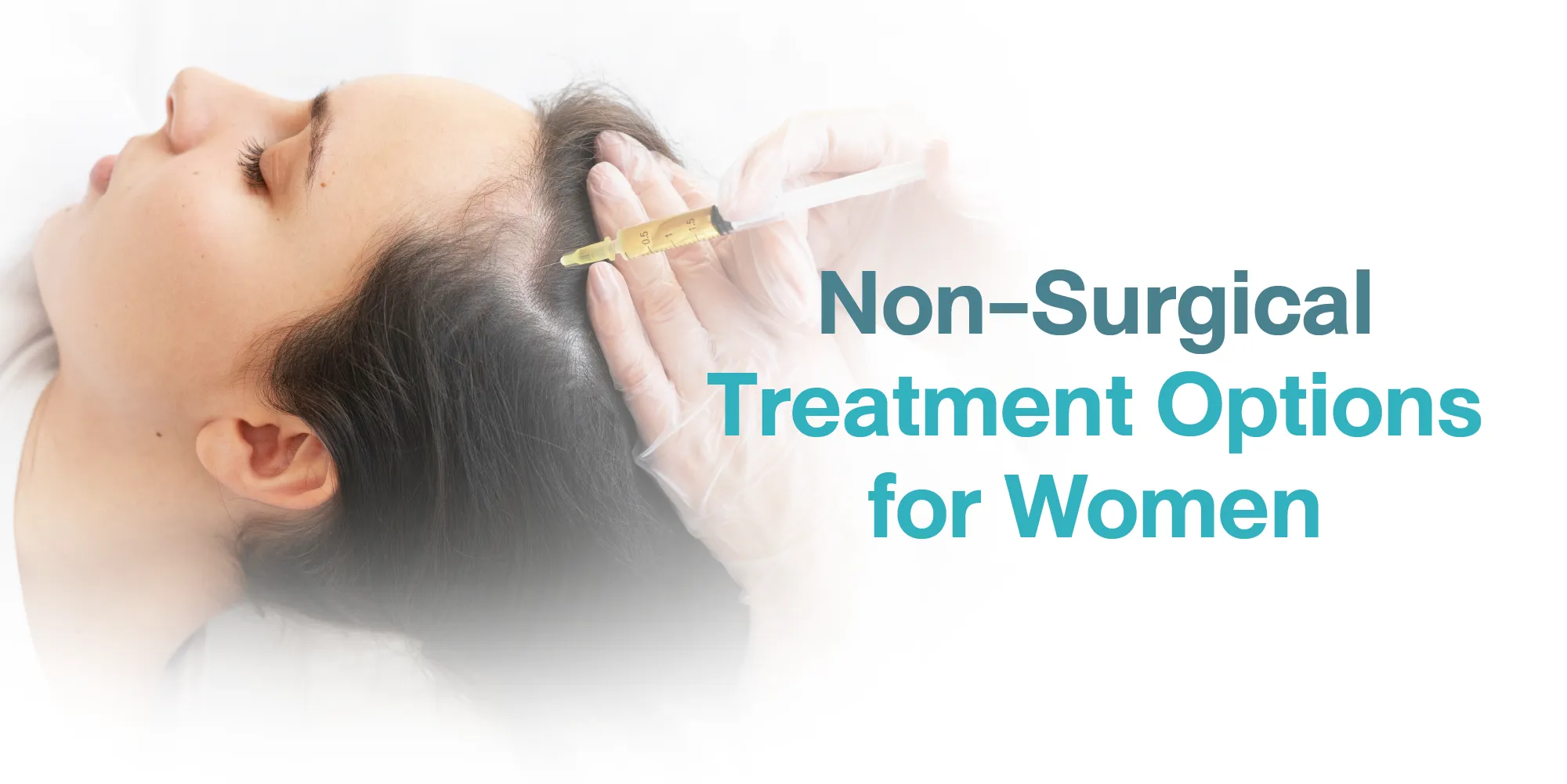
Non-Surgical Treatment Options for Women
The goal is to strengthen the hair root environment, reduce inflammation, and improve the quality of existing hair.
Fundamental Lifestyle Adjustments That Impact Results
- Get enough sleep and manage stress: Set a consistent sleep schedule and practice relaxation techniques.
- Eat a complete diet: Focus on protein, healthy fats, iron, vitamins, and minerals from whole foods.
- Scalp care: Use gentle products. If you have an inflammatory condition, follow your doctor’s instructions.
- Avoid excessive heat/chemicals: Reduce straightening, perming, dyeing, or tight hairstyles.
Procedures to Revitalize Hair Roots
- PRP (Platelet-Rich Plasma): Uses plasma rich in your own platelets, injected into specific areas to improve the hair root environment. Suitable for early or diffuse thinning. Requires a course of treatments and follow-up.
- Regenera Activa (Micrograft): Uses micrografts from a healthy area to support thinning areas. Suitable for women who want to restore density and still have a fair amount of existing hair roots.
- Medication/Gender-specific treatments: In some cases, a doctor may consider options suitable for women, but a careful assessment of health history, pregnancy/breastfeeding status, and associated risks is crucial.
Results depend on the cause, the stage of the problem, and your discipline in care. Consistent follow-up is as important as the procedure itself.
When to Consider “Hair Transplantation for Women”
If you find clear miniaturization, the thinning area is permanent, and your donor area is strong enough, a hair transplant may be the answer, especially for areas requiring high naturalness, such as the hairline or parting line.
DHI Hair Transplant for Women — Key Advantages for Women
- Harvests grafts using a small punch (similar to FUE), reducing linear scarring.
- Controls the “direction, angle, depth, and density” during implantation, helping the hairline and density gradation look natural.
- Designs the shape and density to suit your face shape, age, and existing hair.
- Includes a post-care plan with PRP Boosters and follow-up programs for women to maintain long-term hair quality.
Who is Suitable/Not Suitable?
- Suitable: Women with specific thinning areas (e.g., hairline/parting) who have sufficient donor hair and want highly natural-looking results.
- Special consideration: Those with very widespread diffuse hair thinning or low donor density. The doctor may plan a combination of hair revitalization procedures.
Women-Specific Follow-up Programs: Why “Discipline” is as Important as the “Method”
- Follow-up appointments are scheduled to track real trends, not just feelings.
- Care plans are adjusted according to life stages: postpartum, medication changes, new job, stress, or lack of sleep.
- Photos from the same angle are compared every 2-3 months for a tangible measurement of results.
- A long-term plan balances the desired density with the limited “donor resources.”
Example “Hair Recovery Journey” for Common Situations
- 3-4 months postpartum with heavy shedding: Assess symptoms + blood work as appropriate → Focus on fundamental care/scalp health → Follow up in 3-6 months. If still thin, consider PRP/Regenera as per the doctor’s judgment.
- Widening part from early-stage FPHL: Fundamental care → Hair revitalization procedures (PRP/Regenera) → Photo follow-up → If thinning is specific to the hairline/part and there is enough donor hair, consider DHI hair transplant.
- With accompanying rash/scabs/itching: Treat the scalp inflammation first, then plan for density restoration.
Questions to Ask a Doctor Before Deciding
- Which category does my hair thinning fall into (postpartum, hormonal, thyroid, skin condition, etc.)?
- What blood/hormone tests should I have in my case?
- If I start with PRP/Regenera, how often should I do it, and when can I expect results?
- Is a DHI hair transplant suitable for me? Which areas should be transplanted, and approximately how many grafts will be needed?
- Are there any limitations due to my pregnancy/breastfeeding/current medication?
- What should the long-term follow-up plan be, and how should I adjust if I have periods of shedding?

FAQ
- Q: How many months until postpartum hair loss gets better?
- A: It usually becomes noticeable around 2-4 months postpartum and gradually improves as hormones return to balance, but the actual duration varies. If the shedding lasts abnormally long or the part continues to widen, see a doctor.
- Q: If I’m afraid of scars/long recovery, should I avoid hair transplantation?
- A: It depends on the case. Non-surgical options like PRP/Regenera can help in many situations. But if a hair transplant is necessary, the DHI technique focuses on control during implantation for naturalness and a more predictable recovery.
- Q: Is using hair growth shampoo enough?
- A: It helps with cleanliness and scalp comfort, but if the root cause is hormonal/postpartum/thyroid/skin-related, shampoo alone is often insufficient. A combined care plan is needed.
- Q: Can I have procedures while breastfeeding?
- A: Many can be done, but a doctor must assess the suitability and safety on an individual basis.

Quick Checklist Before Starting Your Hair Recovery Plan
- Have you identified if you are in the “postpartum/hormonal/thyroid/skin condition” category?
- Do you have month-to-month photos from the same angle to track the trend?
- Do you have any inflammation, itching, or scabs (scalp condition must be treated first)?
- Have you set expectations that balance your desired density with your donor resources and recovery timeline?
- Have you planned for 3-6-12 month follow-ups?

Why You Should Start with an “Individual Assessment” at DHI Thailand
- The causes, stages, and life conditions of female hair thinning are different for each person, so the plan must be personalized.
- DHI Thailand focuses on designing natural-looking results, from hair revitalization (PRP/Regenera) to DHI Hair Transplant for Women, which controls the direction, angle, depth, and density during implantation.
- They offer women-specific follow-up programs to maintain long-term hair quality and density.
Female hair thinning can be caused by various factors, from postpartum hair loss to hormonal factors, thyroid issues, stress, and nutrition. There is no single “correct” answer to “how to treat it.” The right approach is to start with a clear assessment of which group you belong to and what stage your hair loss is at, then choose a suitable path, from fundamental care and hair revitalization procedures to a DHI hair transplant in necessary cases. The sooner you plan and the more consistently you follow up, the higher your chance of regaining naturally full hair.
Consult about your hair recovery journey with DHI Thailand for a personalized plan and to schedule a hair/scalp examination.